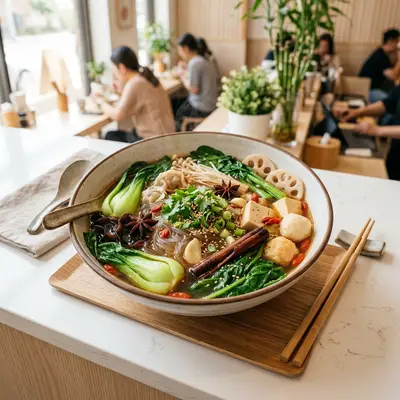
Authentic Homemade Malatang Recipe | Recreate the Restaurant Flavor in 15 Minutes
目次
- Homemade Authentic Malatang — You Only Need These 3 Things
- Authentic Malatang Ingredients (Serves 2)
- How to Make Authentic Malatang | 4 Steps (About 15 Minutes)
- 3 Tips for Taking It to the Next Level
- Quick Version Using Store-Bought Bases (10 Minutes)
- Q&A | Common Questions About This Malatang Recipe
- Nutrition Notes | Even the Authentic Recipe Comes in Around 500 kcal
- Summary | Authentic Malatang Comes Down to Sichuan Pepper, Glass Noodles, and the Golden Ratio
- Related Articles
Homemade Authentic Malatang — You Only Need These 3 Things
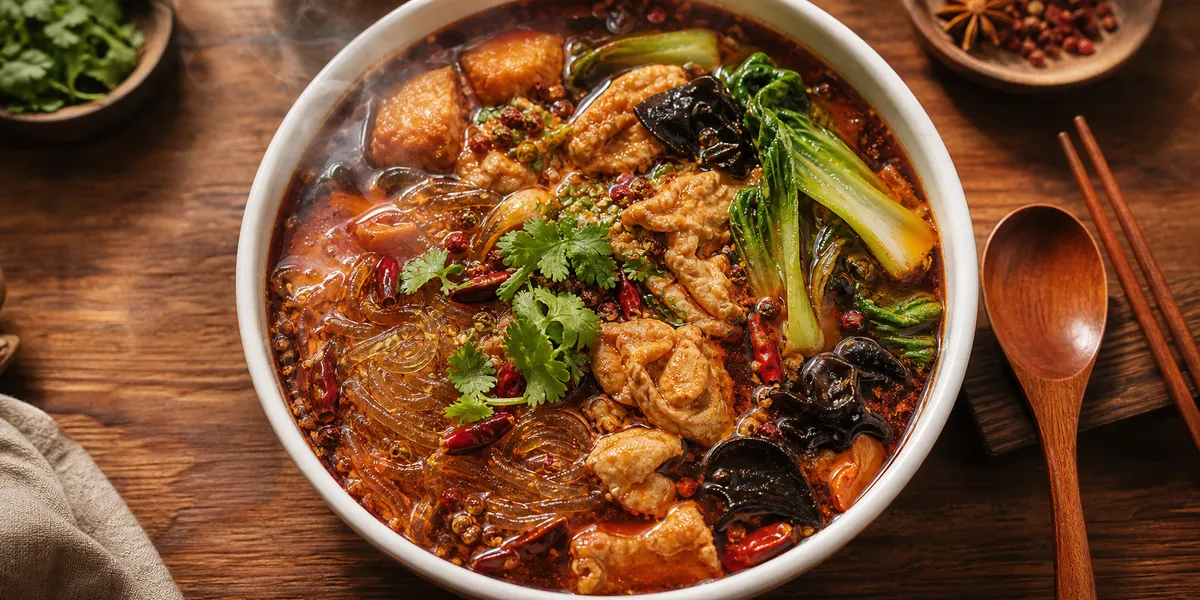
Think malatang (málà soup) can only be enjoyed at a specialty restaurant? In fact, if you nail just three elements — the golden-ratio broth, Sichuan peppercorns, and glass noodles — you can make an authentic bowl at home in 15 minutes.
This page covers everything: a two-serving ingredient list, how to simmer the broth, three tips for stepping up the authenticity, a quick version using store-bought bases, and a Q&A section. It's also useful if you've picked up a ready-made base from a grocery store but want to get one step closer to the real thing.
If you're curious about calories and nutrition, check out the Malatang Calorie Quick-Reference Guide as well.
Authentic Malatang Ingredients (Serves 2)
Here's everything you need for two servings, split into everyday supermarket staples and specialty Chinese ingredients that boost authenticity.
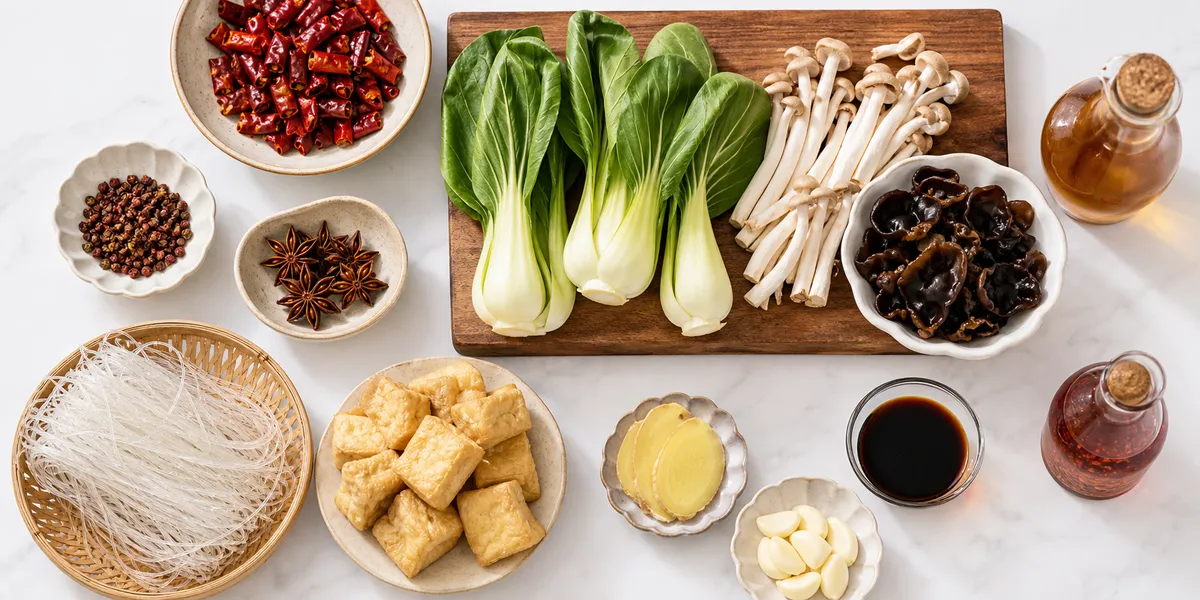
Broth Base (Serves 2 / approx. 900 ml)
Ingredient | Amount | Role |
|---|---|---|
Water | 900 ml | Base |
Chicken stock powder | 1½ tbsp | Umami |
Soy sauce | 1 tbsp | Saltiness and color |
Shaoxing wine | 1 tbsp | Depth and aroma |
Black vinegar | 1 tsp | Lingering depth on the finish |
Sichuan peppercorns (whole) | 1 tsp | Numbing tingle (má) |
Dried chili (coarsely ground) | 1–2 tsp | Heat (là) |
Star anise | 1 piece | Fragrance |
Ginger (thinly sliced) | 3 slices | Eliminates gaminess |
Garlic (smashed) | 1 clove | Aroma |
Chili oil or málà oil | 1 tbsp | Finishing touch |
Noodles & Toppings
Ingredient | Amount | Notes |
|---|---|---|
Glass noodles (mung bean) | 60 g (dried) | Rehydrate in hot water |
Bok choy | 1 head | Quarter lengthwise |
Wood ear mushrooms (dried) | 5 g | Rehydrate in water |
Shimeji mushrooms | ½ pack | Trim the base |
Thick-fried tofu (atsuage) | ½ piece | Cut into bite-sized pieces |
Chicken breast | 100 g | Slice thinly on the bias |
Quail eggs (canned/boiled) | 4 eggs | Use as-is |
Cilantro (coriander) | To taste | For garnish |
Equipment
- Pot approx. 20 cm in diameter (at least 8 cm deep recommended)
- Colander and bowl (for rehydrating glass noodles)
- Ladle and cooking chopsticks
How to Make Authentic Malatang | 4 Steps (About 15 Minutes)
Here's the actual cooking process. Simmering time is short and everything cooks over medium heat, making this easy to pull off on a weeknight.
Step 1 | Simmer the Broth (10 minutes)
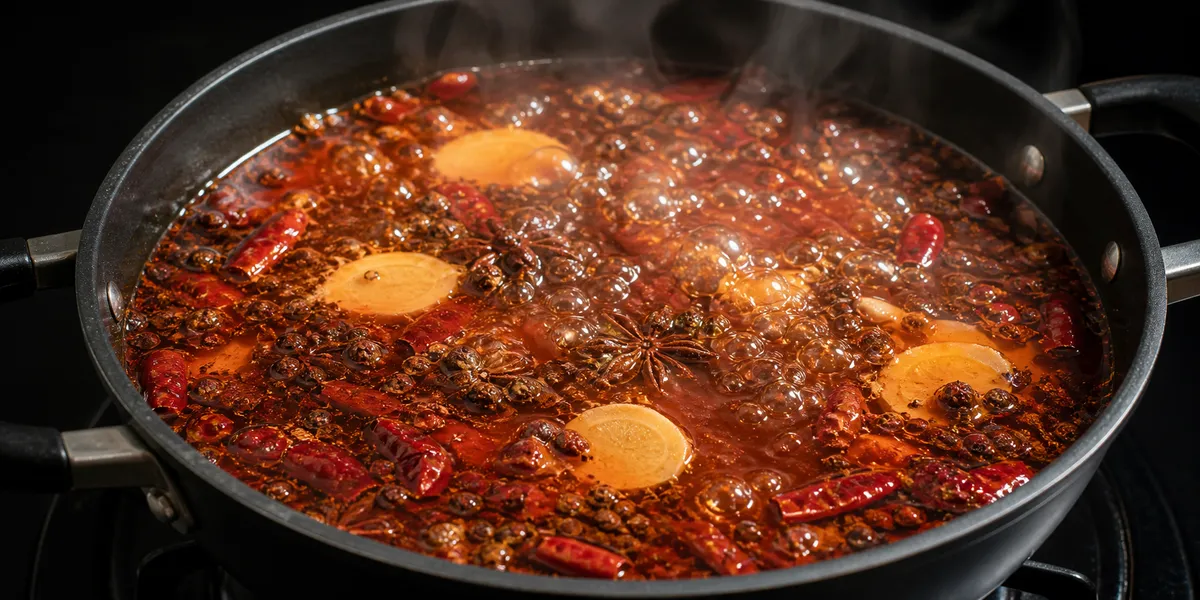
- Add 900 ml of water, chicken stock powder, soy sauce, Shaoxing wine, ginger, garlic, star anise, and dried chili to a pot and bring to a boil over medium heat.
- Once boiling, reduce to low and simmer for 7–8 minutes to draw out the aromatics.
- Just before turning off the heat, add the Sichuan peppercorns and simmer for 30 seconds only (adding them too early can make the broth bitter).
Step 2 | Rehydrate the Glass Noodles (5 minutes)
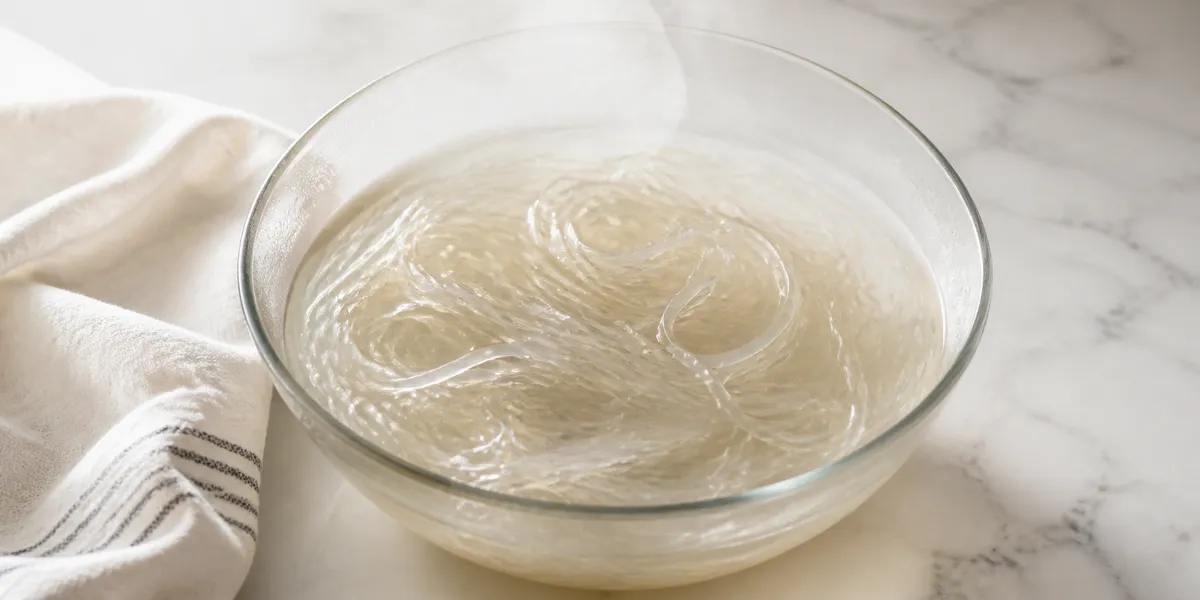
- Fill a bowl with warm water (around 60°C / 140°F) and soak 60 g of glass noodles for 5 minutes.
- Drain in a colander and shake off excess water.
- If the noodles are too long, cut them in half with kitchen scissors.
Step 3 | Par-Cook the Toppings (3 minutes)
- Add the chicken breast, rehydrated wood ear mushrooms, shimeji, and thick-fried tofu to the broth from Step 1.
- Simmer over medium heat for 2 minutes.
- Add the bok choy and quail eggs and cook for 1 more minute.
Step 4 | Finish and Plate
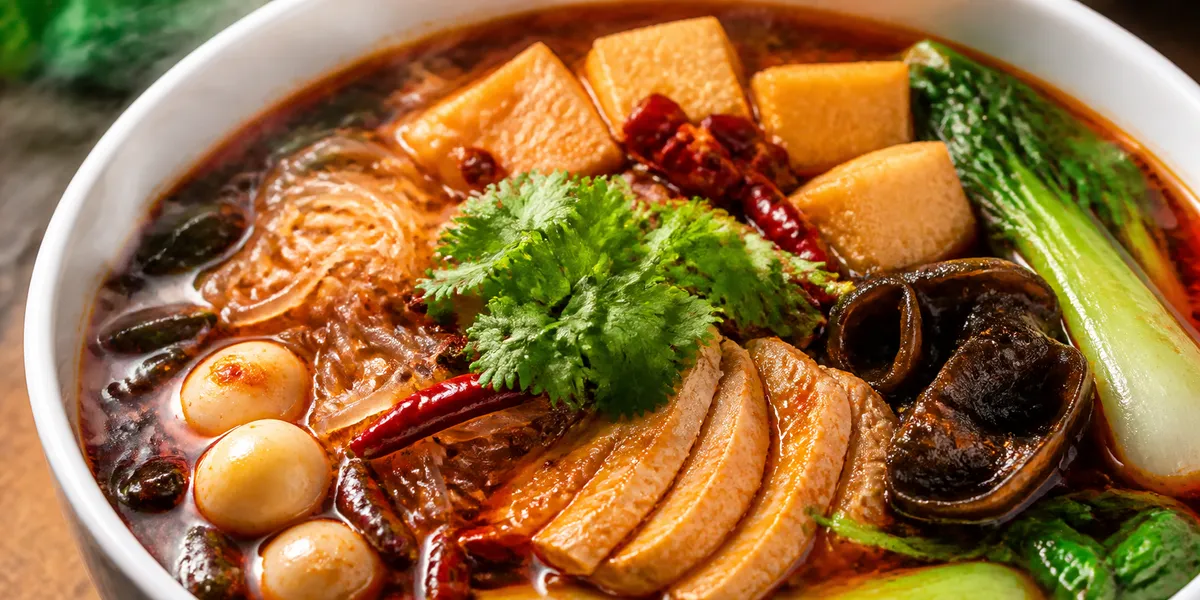
- Divide the glass noodles from Step 2 between two bowls.
- Ladle the broth and toppings over the noodles.
- Drizzle 1 tablespoon of chili oil (or málà oil) over each bowl, top with cilantro, and serve.
In just 15 minutes, you have a bowl on par with a specialty restaurant.
3 Tips for Taking It to the Next Level
If you've tried a store-bought base and feel like something is missing, give these three tips a shot.
Tip | Effect | Difficulty |
|---|---|---|
Use homemade málà oil as a finishing drizzle | Aroma and heat on a completely different level | ★★☆ |
Add coarsely ground Sichuan pepper right before serving | Creates a layered, three-dimensional numbing sensation | ★☆☆ |
Stir in 1 tsp of black vinegar | Adds depth to the finish | ★☆☆ |
Tip 1 | Quick Homemade Málà Oil Recipe
Store-bought chili oil works well, but homemade málà oil instantly brings you closer to that specialty-restaurant aroma.
Ingredients (easy-to-make batch — fills one airtight jar)
- 100 ml neutral oil (e.g., vegetable oil)
- 1 tbsp sesame oil
- 2 tbsp coarsely ground dried chili
- 1 tsp whole Sichuan peppercorns
- 1 star anise
- 2 thin slices of ginger
- 5 cm of the green part of a scallion
Method
- Combine the neutral oil, sesame oil, ginger, scallion, and star anise in a small saucepan and heat over low for 5 minutes.
- Once fragrant, remove and discard the ginger, scallion, and star anise.
- Place the dried chili and Sichuan peppercorns in a heatproof container, then pour the hot oil over them all at once.
- Let cool completely, then store in an airtight container in the refrigerator (keeps for up to 1 month).
Just a tablespoon drizzled over your bowl at the end brings it much closer to restaurant quality.
Tip 2 | Add Coarsely Ground Sichuan Pepper Right Before Serving
After using whole peppercorns to flavor the broth, finish with a pinch of coarsely ground Sichuan pepper for a layered numbing kick. Freshly ground makes a world of difference in fragrance.
Tip 3 | Stir in 1 tsp of Black Vinegar for Depth
This isn't enough to make the dish taste sour — it's a secret ingredient that draws out richness on the finish. Zhenjiang (Chinkiang) black vinegar is ideal, but regular black vinegar works fine too.
Quick Version Using Store-Bought Bases (10 Minutes)
If you want something fast on a weeknight, or just don't want to risk a misstep, lean on a store-bought base.
Product type | Time needed | Authenticity | Best for |
|---|---|---|---|
Kaldi malatang base | 10 min | ★★★ | Beginners, single serving |
Business Super (Gyomu Super) hot pot broth | 12 min | ★★☆ | 2–4 servings |
Mail-order retort from a specialty restaurant | 5 min | ★★★★ | A special treat |
Even with the quick version, simply adding extra Sichuan peppercorns, finishing with homemade chili oil, and topping with cilantro and bok choy lifts authenticity dramatically. If you're not sure what to add, the Malatang Healthy Toppings Guide is a helpful reference.
Q&A | Common Questions About This Malatang Recipe
Q. Can I make it without Sichuan peppercorns?
A. You can, but the signature numbing tingle (má) that defines malatang comes only from Sichuan peppercorns. The closest substitute is Japanese sansho pepper, which has a similar but brighter and milder flavor — use about 1.5 times the amount of Sichuan pepper. You can find it in the spice aisle or Chinese ingredient section of most supermarkets for around 100–500 yen.
Q. How many grams of glass noodles per serving?
A. 30 g dried (about 100 g rehydrated) is the standard single serving. If you want a more filling bowl, up to 40 g is fine. The same 30 g applies if you swap in rice vermicelli (bihun/rice noodles).
Q. How do I adjust the heat level?
A. Heat (là) is controlled by the dried chili and chili oil; the numbing tingle (má) is controlled separately by the Sichuan peppercorns.
- To reduce heat: cut the dried chili in half and reduce chili oil to 1 tsp
- To reduce the numbing sensation: cut Sichuan peppercorns to ½ tsp, or skip the coarsely ground finishing pepper
- For a completely non-spicy malatang: refer to the Non-Spicy Malatang Selection Guide and make a clear-broth (qīngtāng) version
Q. How do I adapt this for kids?
A. Leave out the dried chili, Sichuan peppercorns, and chili oil entirely, and make a Chinese-style soup based on chicken stock, soy sauce, and Shaoxing wine (or dry white wine). A drizzle of sesame oil at the end gives a kid-friendly Chinese-style glass-noodle soup. For adults at the same table, simmer málà oil separately and add it to their bowls at the end.
Q. How long does it keep?
A. With the broth and toppings combined, it keeps up to 2 days refrigerated. Glass noodles absorb the broth over time and turn mushy, so it's best to store the glass noodles in a separate container. Reheat over medium heat for about 3 minutes.
Q. What's the difference between malatang and hot pot?
A. The key difference is that malatang is an individual-sized spicy noodle soup, while hot pot is a communal dish everyone cooks together at the table. For a detailed breakdown, see Malatang vs. Hot Pot — What's the Difference?
Nutrition Notes | Even the Authentic Recipe Comes in Around 500 kcal
This recipe totals approximately 1,000 kcal for two servings, or about 500 kcal per serving. Here's the breakdown:
- Glass noodles 30 g (rehydrated): approx. 100 kcal
- Chicken breast 50 g: approx. 55 kcal
- Thick-fried tofu ¼ piece: approx. 60 kcal
- Vegetables and mushrooms: approx. 30 kcal
- Broth + oil: approx. 250 kcal
Compared to a bowl of ramen, it's a lighter option that still delivers a balanced mix of vegetables, mushrooms, and protein. Per-ingredient calorie details are listed in the Malatang Calorie Quick-Reference Guide.
Summary | Authentic Malatang Comes Down to Sichuan Pepper, Glass Noodles, and the Golden Ratio
- The broth is defined by the golden ratio of chicken stock + Shaoxing wine + soy sauce + black vinegar + Sichuan peppercorns
- Glass noodles should be soaked in warm water for 5 minutes — don't over-simmer them
- Use a two-stage Sichuan pepper approach: whole peppercorns for aroma, coarsely ground for the finish
- Even the shortcut version shines when you add a store-bought base + homemade chili oil + extra Sichuan pepper
- At about 500 kcal per serving, it's healthy enough to rotate into your weekly menu without a second thought
A fully authentic malatang — spicy and numbing in perfect harmony — costs under 300 yen per serving when you make it at home. Give it a try this weekend.
Related Articles
- Malatang Calories and How to Eat Without Gaining Weight → /blog/malatang-calorie
- How to Choose Healthy Malatang Toppings → /blog/malatang-kenko-guzai
- Non-Spicy Malatang Selection Guide → /blog/malatang-karakunai-erabikata
- Malatang vs. Hot Pot — What's the Difference? → /blog/malatang-hyouki-hinabe-chigai
Find malatang near you
Search authentic malatang spots by area or nearest station →
Related articles
The Complete Guide to Chinese Glass Noodle Salad | Diet-Friendly Ratios, Meal Prep, and Calorie Breakdown
The Complete Guide to Japchae: Authentic Korean Recipe, Choosing Dangmyeon, and a Dieter's Perspective
Malatang Spelling Guide: "麻辣湯" or "麻辣担"? Plus How It Differs from Hot Pot