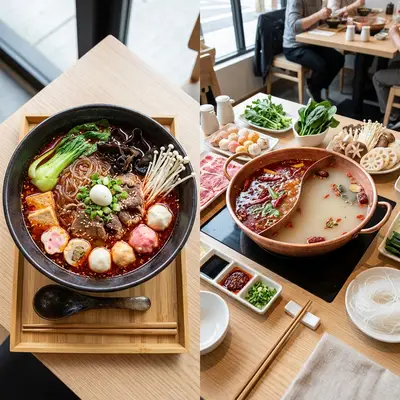
How Much Is a Bowl of Malatang? How By-Weight Bills Work and Prices by Shop
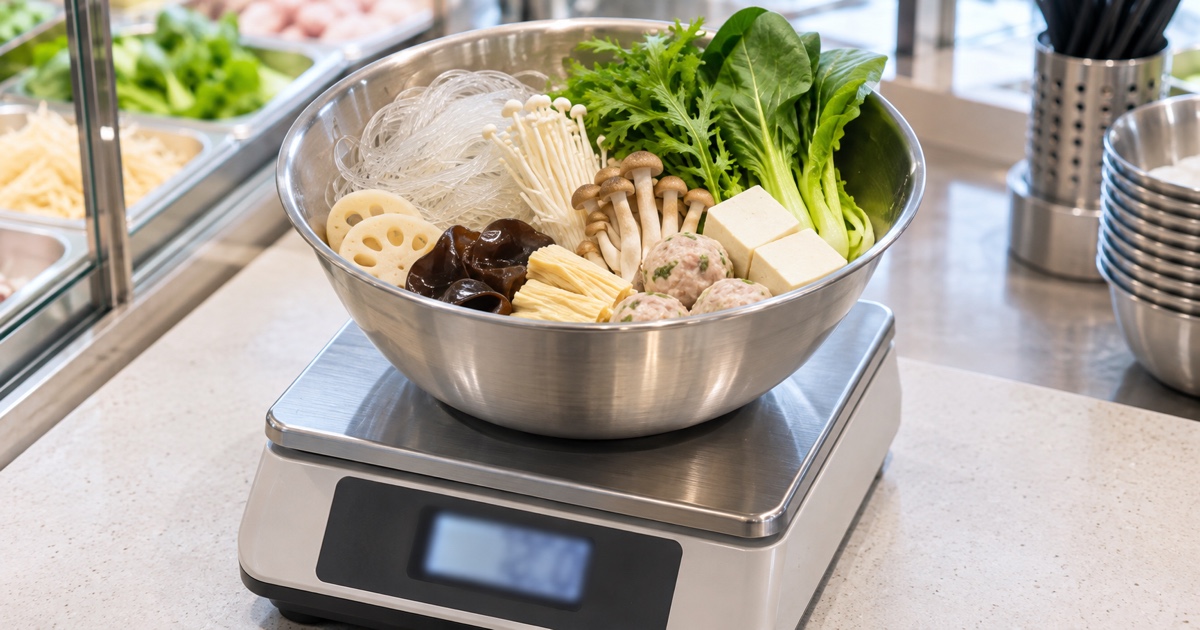
At shops that sell by weight, the price of one bowl of malatang is "base price (soup and glass noodles) + weight of ingredients x the price per 1g." At the chains whose prices can be confirmed on their official sites, the base price is 620 yen and ingredients cost 3.1 to 3.7 yen per gram. Taking 150 to 450g of ingredients works out to about 1,100 to 2,300 yen (as of November 2026).
This article covers how the by-weight bill is calculated, prices at chains and independent shops, and how to work backward from your budget to a weight of ingredients. All amounts are calculated from the figures stated on official websites.
Contents
- How much is a bowl of malatang?
- How is a by-weight bill calculated?
- How much does each chain charge?
- How much do independent shops charge?
- How do you decide the weight of ingredients from your budget?
- How much does each ingredient weigh?
- How can you order to keep the bill down?
- Where can you see prices at shops near you?
- Frequently asked questions about malatang prices (FAQ)
- Summary
- Related articles
How much is a bowl of malatang?
There are two main ways shops charge.
Method | How the bill is set | Examples |
|---|---|---|
By weight | A base price (soup + glass noodles or noodles) plus the cost of the weight of ingredients you pick | Qibao Malatang, iSDG Malatang, Xiangxiang Malatang, Marashin Kanayama |
Set price | A price that includes a set number of toppings; extra toppings cost more | Qibao Malatang Shibuya (925 yen incl. 3 items), Tunshe Hot Pot & Malatang Shinsaibashi (748 yen incl. 3 items) |
With by-weight pricing, the bill changes with how much you pick, even at the same shop. At some shops 150g of ingredients comes to the 1,100-yen range, while 450g goes over 2,000 yen, so there is no single answer to "how much." Set-price shops charge by the number of items, so the bill is easier to read.
How is a by-weight bill calculated?
The formula is as follows.
Bill = base price + (weight of ingredients [g] x price per 1g)
Here is an example at Qibao Malatang (by weight) with 300g of ingredients (tax included). Add 3.1 yen per gram x 300g = 930 yen to the base price of 620 yen, for a total of 1,550 yen. You must pick at least 20g of ingredients.
The table below lists calculated bills by weight of ingredients for Qibao Malatang (3.1 yen per 1g, tax included) and Xiangxiang Malatang (3.7 yen per 1g).
Weight of ingredients | Qibao Malatang (tax included) | Xiangxiang Malatang (tax not stated) |
|---|---|---|
150g | 1,085 yen | 1,175 yen |
300g | 1,550 yen | 1,730 yen |
450g | 2,015 yen | 2,285 yen |
The weights are example figures; the actual bill is set by the weight measured at the counter. Whether the weight of noodles or glass noodles counts toward the ingredients differs by shop, so follow the in-store guidance.
How much does each chain charge?
The chains whose prices could be confirmed on their official website or an official announcement are the following three. Detailed menus for each chain are on the chain pages.
Chain | Method | Base price | Price per ingredient | Tax notation |
|---|---|---|---|---|
By weight (except Shibuya and Iidabashi) | 620 yen (soup + glass noodles) | 3.1 yen per 1g (from 20g) | Tax included | |
Small-bag set (topping set) | 925 yen (3 toppings + soup + glass noodles) | 150 yen for each extra item | Tax included | |
By weight | 620 yen (soup + noodles) | 3.1 yen per 1g | Not stated | |
By weight | 620 yen (soup + glass noodles) | 3.7 yen per 1g (from 20g) | Not stated |
At Qibao Malatang, choosing "no glass noodles" takes 50 yen off at by-weight shops and gives you 1 free topping at small-bag shops.
For the following chains, the price per gram and base price cannot be confirmed on their official sites. Checking the price list in the shop is the surest way to choose.
At Ippin Malatang, Haomeiwei, Panda, and Zhang Liang, the pricing system changes by shop and by time. Check the page of the shop you want to visit from the chain list.
How much do independent shops charge?
These are by-weight prices at independent (non-chain) shops whose official sites list tax-included prices (as of November 2026). The calculated value for 300g, based on the price per 100g, is also shown. Whether soup or noodles are included in the unit price or charged separately differs by shop, so treat these as a guide to the bill.
Shop | Per 100g (tax included) | Calculated for 300g | Note |
|---|---|---|---|
Marashin Kanayama | 400 yen | 1,200 yen | Minimum 250g |
Gofu Malatang | 385 yen | 1,155 yen | Measured in 10g units |
Satsuminami Malatang (Sapporo) | 390 yen | 1,170 yen | 3.9 yen per 1g |
Liu-chan Malatang | 450 yen | 1,350 yen | Base price (by weight) |
Karakara Malatang (Yoyogi, Ikebukuro, Mita) | 440 yen | 1,320 yen | Ingredients per 100g |
Independent shops with set prices or a base-price system are as follows (tax included).
Shop | Price | What is included |
|---|---|---|
Tunshe Hot Pot & Malatang Shinsaibashi | 748 yen | 3 toppings |
Akasaka Malatang Sapporo | Base price 750 yen | Basically 4.1 yen per 1g |
Malontang Kisarazu | 682 yen eat-in (620 yen before tax) | Soup + glass noodles. Takeout is 669 yen |
How do you decide the weight of ingredients from your budget?
At by-weight shops, you can predict the bill by setting a budget first and working backward to a weight of ingredients. The formula is "(budget - base price) / price per 1g."
Budget | Qibao Malatang (base 620 yen, 3.1 yen per 1g) | Xiangxiang Malatang (base 620 yen, 3.7 yen per 1g) |
|---|---|---|
1,500 yen | Up to about 283g of ingredients | Up to about 237g of ingredients |
2,000 yen | Up to about 445g of ingredients | Up to about 372g of ingredients |
Some shops charge extra for spice levels or flavor customization, so leaving a little room is safer.
How much does each ingredient weigh?
Even when your budget gives you a weight, it is hard to choose without knowing what to pick to reach that weight. The table below shows the approximate weight of one piece or one pack of ingredients of typical size (the weight after removing the parts that are thrown away). Cuts and sizes differ by shop and the bill is set by the weight measured, so use this as a rough guide before you pick.
Type | Ingredient (unit) | Approximate weight |
|---|---|---|
Leafy greens | Komatsuna (1 plant) | 30g |
Leafy greens | Bok choy (1 plant) | 40g |
Leafy greens | Spinach (1 plant) | 30g |
Vegetables | Broccoli (1 floret) | 15g |
Vegetables | Baby corn (1 piece) | 10g |
Mushrooms | Enoki (1 pack) | 100g |
Mushrooms | Shimeji (buna-shimeji, 1 pack) | 100g |
Mushrooms | Maitake (1 pack) | 100g |
Mushrooms | Shiitake (1 piece) | 15g |
Soy products | Tofu (1 block) | 300g |
Soy products | Atsuage (thick fried tofu, 1 piece) | 120g |
Soy products | Aburaage (thin fried tofu, 1 piece) | 30g |
Meat and eggs | Wiener sausage (1 piece) | 20g |
Meat and eggs | Chicken tenderloin (1 piece) | 50g |
Meat and eggs | Pork (for ginger pork, 1 slice) | 30g |
Meat and eggs | Quail egg (1 egg) | 10g |
Seafood | Scallop (1 piece) | 30g |
Seafood | Vannamei shrimp (1 shrimp) | 20g |
To make 300g, for example, take 3 plants of komatsuna (90g), 4 shiitake (60g), 1 piece of aburaage (30g), 2 wiener sausages (40g), and 2 scallops (60g), for a total of 280g. With mushrooms alone, one pack (100g) each of enoki, shimeji, and maitake makes 300g. One block of tofu (300g) alone counts as 300g of ingredients, which works out to a bill of 1,550 yen at Qibao Malatang.
Source: Eatreat, "Guide to Typical Food Portions": the vegetables edition (published September 26, 2025), the fruits, potatoes, and mushrooms edition (published November 14, 2025), and the meat, seafood, eggs, soy products, and dairy edition (published November 28, 2025). Checked on November 12, 2026.
How can you order to keep the bill down?
- Choose no glass noodles. At Qibao Malatang by-weight shops, this takes 50 yen off.
- Before picking ingredients, set an upper limit on weight from your budget. The backward-calculation table above can help.
- If you want an easy-to-read bill, choose a set-price shop where the number of toppings is fixed.
For how to choose ingredients, see How to choose malatang ingredients; if you want to cut calories, the article on malatang calories can help.
Where can you see prices at shops near you?
On shop search, cards for shops with confirmed prices show the price per 100g or the base price. Together with the spice level, this helps you choose where to go. For an explanation of malatang itself, see What is malatang (mala tang)?.
Frequently asked questions about malatang prices (FAQ)
Q. About how much is one bowl of malatang?
At by-weight shops, calculated for the chains whose prices are confirmed officially, 150g of ingredients is about 1,100 yen, 300g is about 1,500 to 1,700 yen, and 450g is about 2,000 yen (Qibao Malatang: 1,085 yen, 1,550 yen, 2,015 yen; Xiangxiang Malatang: 1,175 yen, 1,730 yen, 2,285 yen; as of November 2026). It changes with the amount of ingredients you pick.
Q. How is a by-weight bill calculated?
Add the weight of ingredients x the price per 1g to the base price (soup and glass noodles or noodles). At Qibao Malatang, it is the base price of 620 yen + 3.1 yen per gram x the weight of ingredients (tax included). You pick at least 20g of ingredients.
Q. Are malatang prices tax included or not?
Qibao Malatang officially states that all prices are tax included. Xiangxiang Malatang and iSDG Malatang do not officially state whether prices include tax. The prices in the independent-shop tables are the tax-included figures on the official sites (Malontang Kisarazu is 682 yen tax included for eat-in; the official figure is 620 yen before tax).
Q. Does choosing no glass noodles make it cheaper?
At Qibao Malatang, it takes 50 yen off at by-weight shops and gives 1 free topping at small-bag shops. For other chains, check in the shop.
Summary
- A by-weight bill is the base price + the weight of ingredients x the price per 1g
- The 3 chains with official prices have a base price of 620 yen and ingredients at 3.1 to 3.7 yen per gram
- With 300g of ingredients, the calculation is 1,550 yen at Qibao Malatang and 1,730 yen at Xiangxiang Malatang
- From your budget, (budget - base price) / price per gram sets the upper limit on the weight of ingredients
Related articles
Find malatang near you
Search authentic malatang spots by area or nearest station
Related articles

Sukiya's "Beef & Sesame Malatang Hot Pot Set" — How Long Is It Available? Price, Taste & Takeout Info [May 2026 Update]

【Complete Guide】Shabu-yo Malatang Fair: Full Archive, Next Fair Predictions & Customization Tips

The Complete Bamiyan Malatang Guide | Regular Menu, Past Specials & Next Event Predictions